
- All
- Product Name
- Product Keyword
- Product Model
- Product Summary
- Product Description
- Multi Field Search

Views: 36 Author: Site Editor Publish Time: 2025-11-10 Origin: Site
Stitchbonded fabric has rapidly gained recognition as one of the most versatile and sustainable materials available today. Its unique structure, combining multiple layers of fibers with interlocking stitches, gives it exceptional strength, durability, and adaptability across diverse industries. From automotive interiors and home textiles to construction membranes and industrial protective layers, understanding the manufacturing process of stitchbonded fabric is crucial for engineers, technical buyers, and product developers. Knowledge of the production steps and key specifications helps ensure that the material selected will perform reliably in its intended application.
At LEEBO, our commitment to innovation and quality has allowed us to become a leading supplier of high-performance stitchbonded fabrics. Founded in 2002, we have continuously invested in advanced production equipment, sustainable fiber sourcing, and process optimization. Our recent expansion to a larger, state-of-the-art facility has enhanced both production capacity and environmental efficiency, allowing us to deliver consistent, high-quality fabrics to clients worldwide. Understanding our stitchbonding process provides insights into why LEEBO fabrics are trusted in demanding applications, and how specifications such as fiber type, web density, and stitch patterns influence overall performance.
The stitchbonding process is a combination of traditional textile craftsmanship and advanced engineering technology. Each step—from fiber selection to finishing—affects the mechanical and physical properties of the fabric, determining its suitability for different applications.
The first stage of producing stitchbonded fabric is web formation, which establishes the fabric’s base structure. At LEEBO, we use recycled polyester fibers ranging from 80% to 95% content. These fibers are carefully cleaned, sorted, and processed to remove impurities and ensure uniformity. Fibers are then converted into a loose web using methods such as air-laying, dry-laying, or carding. The orientation and density of fibers within this web are critical parameters. A tightly packed web increases tensile strength and abrasion resistance, making it suitable for industrial applications, whereas a more open, lighter web allows for flexibility and comfort in home textiles or automotive linings.
Advanced machinery ensures even distribution of fibers, minimizing weak points in the fabric. The precision of web formation directly influences downstream properties such as thickness, density, and mechanical resilience. Technical buyers should pay attention to specifications like grams per square meter (GSM) and fiber alignment, which can impact the fabric’s ability to resist wear, tear, and deformation under load.
Once the web is prepared, it moves to the stitching stage, which is the defining characteristic of stitchbonded fabrics. Multiple needle bars interlock the fibers, creating a stable and flexible network. The type of stitch—chain stitch, tricot stitch, or modified stitch patterns—affects strength, stretch, and dimensional stability. Stitch density, which refers to the number of stitches per inch, is a key determinant of tear resistance and overall durability.
LEEBO’s advanced needle bar systems allow for precise control over stitch tension, depth, and spacing. This is especially important for high-performance applications such as industrial protective layers, construction membranes, and automotive interior linings, where the fabric must withstand mechanical stress, friction, and environmental exposure without failure. Buyers seeking high-strength fabrics should consider requesting fabrics with optimized stitch density and pattern alignment for their specific application.
After stitching, fabrics undergo several finishing steps to improve physical properties, handle, and aesthetic quality. These steps may include:
Heat-setting: Stabilizes the fabric and prevents shrinkage or distortion during use.
Calendering: Smooths the surface and adjusts thickness for uniformity.
Mechanical compacting: Increases density, improving tear resistance and abrasion performance.
These finishing steps are tailored according to the end-use of the fabric. For example, construction-grade membranes may undergo additional compaction and coating to enhance waterproofing, while upholstery backings benefit from a softer, flexible finish. LEEBO’s finishing lines ensure that every roll of stitchbonded fabric meets precise dimensional and mechanical specifications.
The final properties of stitchbonded fabric depend on several interrelated variables. Understanding these allows engineers to specify fabrics that precisely meet performance requirements.
Fiber selection is foundational to performance. Recycled polyester fibers not only reduce environmental impact but also provide excellent strength, elongation, and durability. The fiber length, denier, and purity directly affect the fabric’s tensile strength, hand feel, and dimensional stability. LEEBO provides a detailed fiber composition sheet for each batch, ensuring buyers know the recycled content, fiber type, and technical specifications.
Web density, measured in grams per square meter (GSM), is a critical factor in determining stiffness, compressive strength, and load-bearing capacity. A dense web is preferred for construction membranes, protective industrial layers, and filtration materials, while lower-density webs are ideal for automotive linings, mattress layers, and packaging. LEEBO’s equipment allows precise adjustment of web density for each application, guaranteeing uniform performance across batches.
Stitch patterns influence mechanical performance and aesthetics. Chain stitches, tricot stitches, or hybrid patterns are selected depending on whether the fabric requires flexibility, stretch resistance, or load-bearing strength. The choice of pattern also affects surface appearance, making it relevant for visible applications such as furniture upholstery or decorative textiles.
Yarn denier, or thickness, determines tensile strength, durability, and surface smoothness. Heavier denier yarns improve resistance to abrasion and tearing, whereas finer deniers enhance softness and drape. LEEBO’s production allows precise control over yarn denier, ensuring the fabric meets application-specific demands.
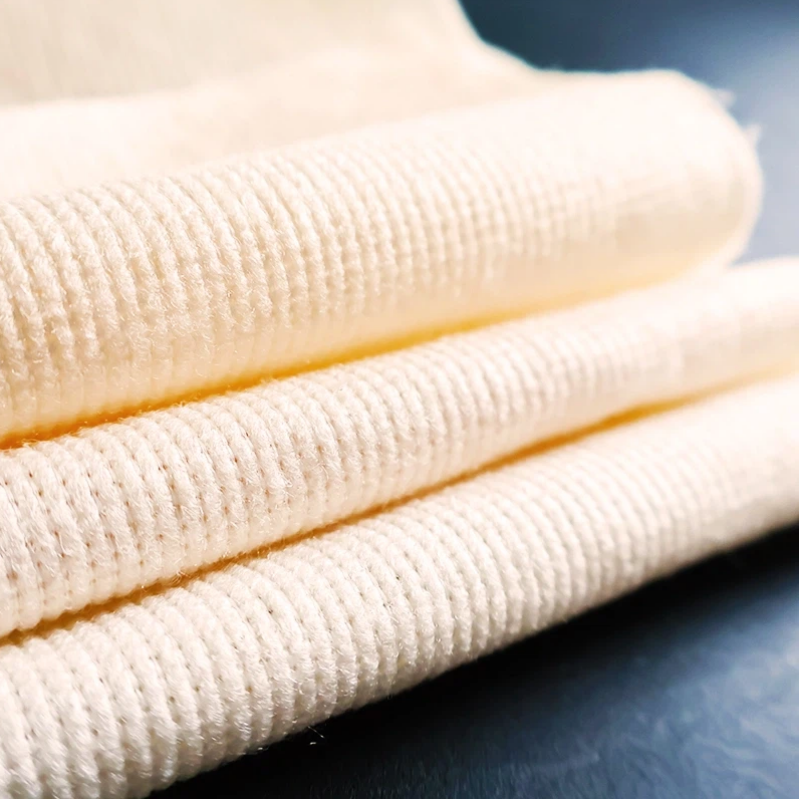
Quality assurance and performance verification are essential. Buyers should request comprehensive lab test reports covering critical metrics:
Tensile testing measures how much force the fabric can withstand before breaking. It is a crucial indicator of durability, particularly for industrial applications, construction membranes, and heavy-duty protective fabrics.
Tear strength testing evaluates how easily the fabric propagates a tear once started. High tear resistance is essential for fabrics exposed to sharp objects or mechanical stress.
Abrasion testing simulates repeated rubbing to assess long-term durability. This test is vital for automotive interiors, furniture upholstery, and industrial protective fabrics.
Burst testing determines the pressure a fabric can endure before rupture. This is particularly relevant for packaging, filtration, and construction applications where high pressure or stress may be encountered.
Dimensional stability ensures the fabric retains its shape, size, and mechanical properties under stress, heat, or moisture. This is critical for applications in home textiles, automotive interiors, and construction membranes.
Stitchbonded fabrics can be enhanced with various finishing treatments to expand their functionality:
Coatings can improve water resistance, chemical resistance, UV protection, and fire retardancy. Laminations add dimensional stability and barrier properties, making fabrics suitable for construction membranes, protective gear, or eco-packaging.
Flame-retardant finishes are applied for automotive interiors, construction fabrics, and industrial protective layers. LEEBO ensures that flame-retardant treatments comply with relevant international safety standards without compromising strength or flexibility.
Hydrophobic coatings repel water and moisture, making stitchbonded fabrics suitable for outdoor applications, protective layers, and eco-friendly packaging. These treatments maintain breathability while enhancing durability.
Ensuring consistent quality is a cornerstone of LEEBO’s production process:
Clients can verify the recycled polyester content in every batch, supporting sustainability initiatives and regulatory compliance. Traceability allows end-users to track materials from raw fiber to finished fabric.
LEEBO operates under ISO-certified quality management systems, guaranteeing systematic control over production, testing, and finishing processes. Each roll undergoes rigorous inspection before shipment.
Clear labeling includes material composition, recycled content, treatment type, and compliance certifications. This transparency ensures buyers and end-users understand the product’s specifications and performance capabilities.
LEEBO’s modern production facility combines automated processes and skilled craftsmanship to deliver high-quality, consistent fabrics while accommodating customization needs:
Minimum Order Quantities: Flexible MOQs allow clients to test samples before scaling production.
Lead Times: Optimized scheduling ensures timely delivery without compromising quality.
Color and Finish Options: Fabrics can be tailored with specific colors, surface textures, and specialized treatments.
Technical Support: Our engineers assist buyers in selecting the right fiber, web density, stitch pattern, and finishing for their unique applications.
Whether used in automotive interiors, industrial protective layers, or sustainable packaging, LEEBO stitchbonded fabric offers reliable performance, eco-conscious composition, and customizable features for demanding applications.
Understanding the production process and critical specifications of stitchbonded fabric empowers technical buyers and engineers to select materials that meet performance, durability, and sustainability requirements. LEEBO combines over 20 years of experience, advanced manufacturing equipment, and strict quality assurance to deliver fabrics suitable for diverse industries, including automotive, home textiles, industrial protection, and construction membranes. With traceable recycled content, detailed lab reports, and customizable finishing options, our fabrics provide both environmental benefits and high mechanical performance. We invite engineers and product developers to contact us to request engineering datasheets, test reports, or schedule a virtual factory tour, and experience the advantages of LEEBO’s advanced stitchbonded fabric firsthand.
Q1: What types of fibers are used in LEEBO stitchbonded fabric?
A1: LEEBO predominantly uses recycled polyester fibers, with 80% to 95% recycled content, providing strength, durability, and sustainability.
Q2: Which lab tests are critical for assessing stitchbonded fabric performance?
A2: Essential tests include tensile strength, tear resistance, abrasion resistance, burst strength, and dimensional stability to ensure reliable performance in different applications.
Q3: How can stitchbonded fabric be customized for specific industrial needs?
A3: LEEBO allows customization of stitch patterns, yarn denier, web density, colors, coatings, laminations, and flame retardant or hydrophobic treatments.
Q4: What industries commonly use stitchbonded fabric?
A4: Stitchbonded fabrics are widely used in home textiles, automotive interiors, industrial protection, construction membranes, inner linings, and eco-friendly packaging solutions.


