- All
- Product Name
- Product Keyword
- Product Model
- Product Summary
- Product Description
- Multi Field Search

Views: 0 Author: Site Editor Publish Time: 2026-08-31 Origin: Site
In-transit load shifting costs global supply chains millions of dollars annually. Damaged products destroy profit margins rapidly. Excessive stretch film usage drains operational budgets. Facilities traditionally relied on basic corrugated separators. They used these simple sheets to divide pallet tiers. Modern logistics now demand specialized friction-enhancing layers. Strategic implementation of an anti-slip pallet liner stabilizes loads effectively. It reduces packaging waste significantly. It improves overall warehouse safety. Operations managers must select the correct material carefully. They must integrate it properly into existing workflows. Relying on outdated methods guarantees ongoing losses. Embracing modern fabric solutions protects your bottom line. We will explore how friction-based materials outperform standard cardboard. You will learn to evaluate materials for closed-loop environments. We will cover implementation strategies for automated systems. You will discover practical steps for shortlisting the best options for your specific supply chain.
Friction-based liners reduce load shifting by increasing the Coefficient of Friction (COF) between stacked tiers.
Switching to an anti-slip fabric liner can decrease reliance on plastic stretch wrap, lowering per-pallet consumable costs.
Evaluating a pallet protection material requires assessing its compatibility with current automated or manual palletizing systems.
Reusable fabric options (like stitchbond liner fabric) offer stronger long-term ROI compared to single-use anti-slip paper, despite higher initial unit costs.
Standard palletizing carries severe baseline risks. Lateral shift during transit causes major product shrinkage. Trucks navigate sharp corners regularly. Drivers brake suddenly in traffic. These dynamic forces push unsecured boxes outward. Unstable loads topple easily inside trailers. This creates massive headaches for receiving docks. Falling boxes also create severe workplace safety hazards. Forklift operators face daily risks from shifting tiers. Falling inventory injures workers frequently. It disrupts daily operations entirely. Damaged inventory requires costly write-offs.
Facilities compensate for this instability poorly. They fall into the over-wrapping trap. Warehouse teams over-apply stretch film constantly. They believe more plastic equals better security. This leads to unsustainable plastic waste. Environmental regulations increasingly penalize excessive plastic disposal. Heavy wrapping also bottlenecks throughput at packaging stations. Operators waste precious minutes securing a single pallet. Wrapping machines run longer cycles. Plastic wrap costs accumulate quickly over thousands of pallets. It hurts the environment and the budget.
A viable solution must stabilize the load effectively from the inside. It should maintain breathability. Some agricultural or chemical products require air circulation. It must keep per-pallet expenses exceptionally low. Operations need predictable performance. Relying solely on external stretch wrap fails these modern requirements. True stability starts between the internal pallet layers. You need a solution designed specifically for friction.
Warehouses historically use corrugated cardboard. Many also rely on Kraft paper sheets. These traditional separators offer minimal grip. They merely separate layers without preventing movement. Paper surfaces slide against carton bottoms easily. Engineered anti-slip solutions solve this fundamental flaw completely.
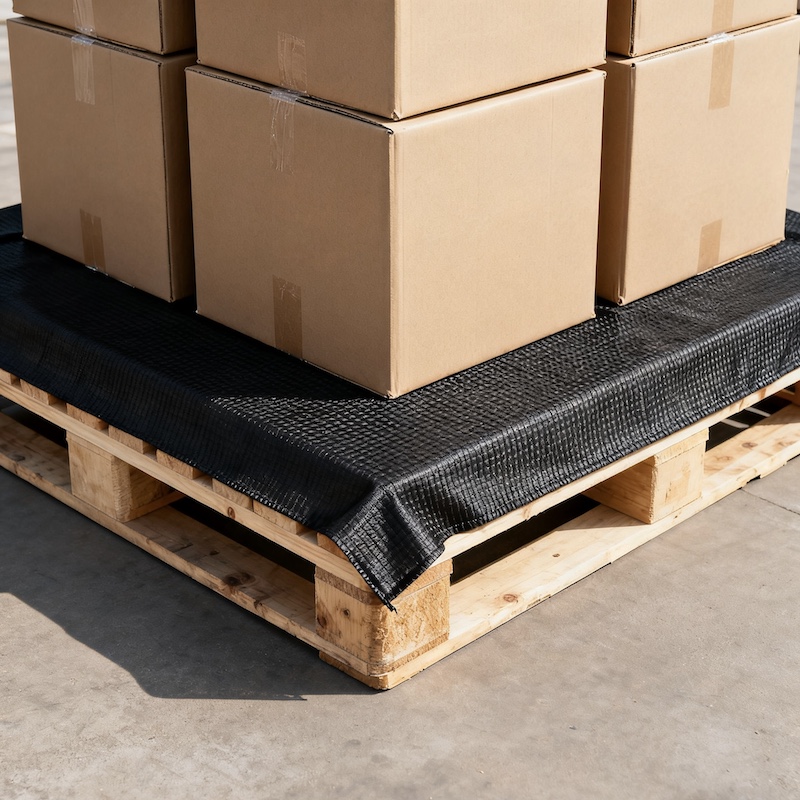
An anti-slip fabric liner works through high surface tension. It increases the Coefficient of Friction (COF) dramatically. This grip prevents layers from sliding laterally. Loads remain stable even at tilt angles up to 45 degrees. The mechanical advantage lies in the micro-texture. This texture grabs packaging surfaces firmly. It performs exceptionally well during sudden transit shifts. We see immediate improvements in load rigidity.
We see distinct benefits when choosing a stitchbond liner fabric over standard friction paper. Standard paper degrades quickly in harsh conditions. It loses structural integrity when wet. It tears under heavy compression. Conversely, stitchbond fabric offers high tear resistance. It provides excellent moisture repellency. You can reuse it multiple times. This structural resilience outperforms single-use alternatives daily. Cardboard compresses over time. Fabric maintains its gripping profile consistently.
Comparison of Pallet Separator Materials
Material Type | Slip Resistance (COF) | Moisture Resistance | Reusability Factor |
|---|---|---|---|
Standard Kraft Paper | Low | Poor (Degrades) | Single-use |
Corrugated Cardboard | Low | Poor (Softens) | 1-2 Cycles |
Anti-Slip Paper | Medium | Moderate | Single-use |
Stitchbond Fabric Liner | High | Excellent | Multi-trip (Washable) |
Best Practice: Always match the separator material to the heaviest product you ship. Heavy items compress paper fast, so fabric becomes necessary for sustained grip.
Common Mistake: Do not stack multiple paper liners thinking it increases friction. It actually creates a slipping plane between the liners themselves.
Calculating return on investment requires a clear framework. Compare the initial cost of liners against tangible operational savings. You save money through drastically reduced stretch wrap usage. You also see lowered damage claims. Fewer rejected shipments improve profit margins. Evaluating your current waste provides a baseline. Subtract the projected wrap reduction from your current spend. Add the value of saved inventory. This justifies the initial material purchase.
Closed-loop supply chains benefit massively from reusable options. Internal transfers allow you to retrieve liners easily. Dedicated transportation fleets can return materials to distribution centers. You can wash and reuse fabric liners periodically. You can run them through multiple internal cycles. This drives down long-term costs significantly. Reusability turns a consumable expense into a durable logistics asset.
A robust pallet protection material adapts to varying conditions. Fabric liners perform exceptionally under diverse loads. They hold heavy liquid totes securely during sharp turns. They also protect fragile fast-moving consumer goods (FMCG). They withstand cold storage condensation much better than paper. They handle dry ambient heat without becoming brittle. High-humidity environments destroy corrugated dividers rapidly. Synthetic fabrics shrug off moisture completely. This reliability prevents mid-transit pallet collapses effectively.
Automated systems present the primary adoption risk. Can automated grippers dispense porous fabric liners successfully? Vacuum cups often struggle initially. They may leak air through porous materials. Operations managers must test porosity limits. They must verify suction requirements early. Mechanical pinch grippers usually perform better for fabrics. Adjusting gripper settings often solves initial pickup issues. You should conduct trial runs before full automation deployment.
Manual workflows require specific operational changes. Fabric liners feel much lighter than heavy rubber mats. However, standard operating procedures (SOPs) remain necessary. Workers must place them completely flat. Folds reduce the effective contact area. Creases compromise load stability entirely. Point-loads from folded fabric damage fragile cartons below. Training warehouse staff ensures proper application. We recommend simple visual guides at packing stations.
Consider the storage footprint in your facility. Compact rolls save valuable warehouse space. Flat sheets take up minimal room in racking. They contrast sharply with traditional materials. Bulky wooden tier sheets consume entire storage bays. Tall corrugated stacks require massive floor space. Fabric liners free up square footage. You can store more revenue-generating inventory. Space optimization matters deeply in high-density facilities.
Procurement teams need objective criteria for vendor selection. Random purchasing leads to incompatible materials. You must evaluate specific dimensions rigorously. We recommend looking closely at three main evaluation dimensions.
COF Ratings: Request verifiable Coefficient of Friction testing data. The manufacturer must prove their claims mathematically. Dynamic friction testing matters most for transit.
GSM (Grams per Square Meter): Match fabric weight to your transit environment. Aggressive shipping lanes require higher GSM. Lightweight products might survive on lower GSM fabrics safely.
Customization: Check if the supplier offers custom cuts. You might need specific sizes for Euro pallets. You may handle oversized industrial skids. Continuous roll options provide flexibility for automated cutting machines.
Do not rush into full-scale procurement blindly. Follow these exact next-step actions to validate your choice.
Request a sample pack from your chosen supplier.
Conduct a localized tilt test in your facility using real products.
Run a limited trial on a historically high-damage shipping lane.
Measure the stretch film reduction during the trial.
Compare damage rates before standardizing the material company-wide.
Upfront costs run higher than standard Kraft paper. However, the operational savings justify the investment completely. Reduced damage makes fabric liners a financially sound choice. Lower plastic consumption aligns beautifully with modern sustainability goals. These materials optimize logistics effortlessly. Reusable liners transform disposable packaging into reliable logistics assets. We encourage logistics managers to act decisively today. Audit your current stretch-wrap spend immediately. Request material samples from trusted suppliers. Test COF limits in your own facilities. You will see immediate stability improvements. Protect your shipments efficiently. Enhance warehouse safety using engineered fabrics.
A: No. They are designed to work *with* stretch wrap. They secure the internal layers (preventing lateral shift), allowing you to significantly reduce the layers of stretch wrap needed for external containment.
A: Discuss the sustainability angle—while typically made of synthetic fibers (like polyester/RPET), their environmental benefit comes from multi-trip reusability and the drastic reduction of single-use plastic stretch film.
A: Yes. Unlike paper, which absorbs moisture and loses structural integrity, non-woven and stitchbond fabrics resist condensation, maintaining their anti-slip properties in refrigerated logistics pallet liner applications.